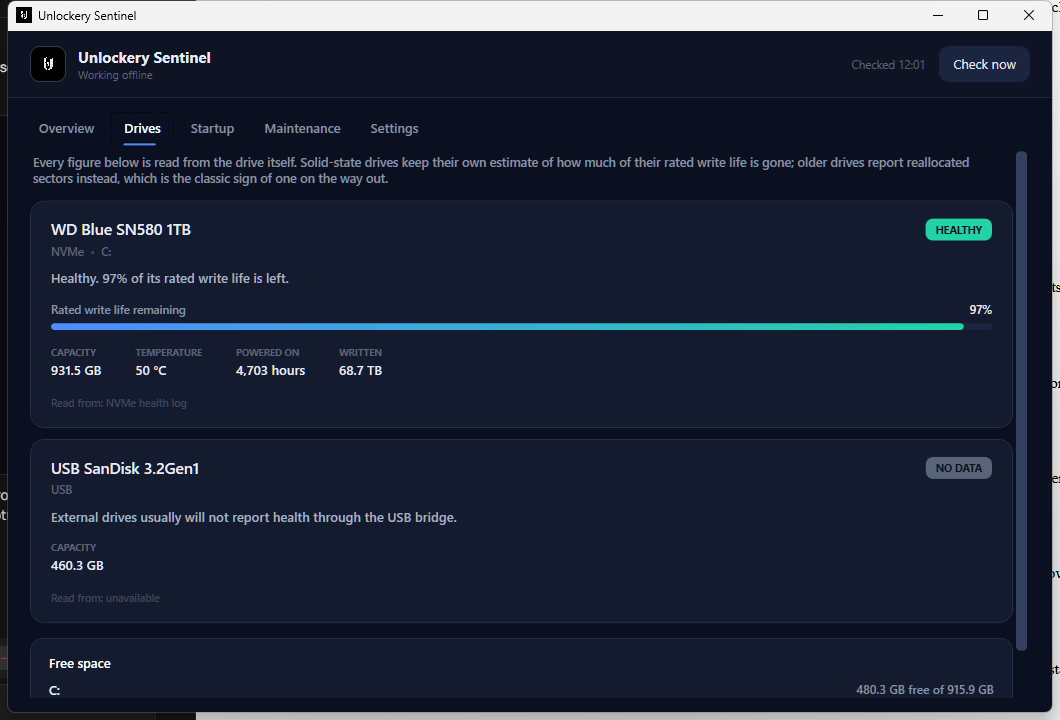
Can it really tell my drive is going to fail?
It can tell you what the drive says about itself, which is the same data the
manufacturer's own tools use: write life spent, spare blocks left, sectors that
could not be read, and the drive's own failure prediction flag. That catches wear
and gradual decline, which is how most drives go. It cannot predict a controller
dying suddenly — nothing can. Keep backups either way.
Why does it need administrator rights?
Because reading a drive's health record and opening the boot performance log both
require them. There is no way around it. Sentinel asks for nothing else and writes
nothing to your system beyond its own history file.
Will it get me banned? I play games with anti-cheat.
No. Sentinel never touches a game. It reads system-wide counters that Task Manager
reads, your drive's own health log, and the title of whichever window is in front.
It opens no process, reads no memory, injects nothing and draws no overlay. There is
nothing for an anti-cheat to object to — it was built and tested alongside Rainbow
Six Siege running.
Does it show my FPS?
No, and it will not pretend to. Reading a game's frame rate honestly means hooking
into it, which is exactly the thing that gets people banned. Sentinel measures the
machine around the game instead — the CPU speed, the drive temperature, the memory,
the connection — which is where the causes of bad frames actually live.
Does it slow my PC down?
It does a full check four times a day and sits idle in between. A check reads a few
hundred bytes from each drive and takes well under a second.
Does my data go anywhere?
No. The history lives in one file on your PC. The only thing Sentinel sends over the
internet is a check that your licence is still valid.
How long before it is useful?
The drive health, the startup list and the battery reading are all there on the
first run. The forecasts — how fast a drive is wearing, when a disk fills up —
need history, and start appearing after about a fortnight of it running.
Can I use one key on my desktop and my laptop?
Not on a single-PC licence — a key works on one machine. The 3 PCs plan covers
three, which is usually the honest answer for a desktop, a laptop and the machine
in the other room.
I already have the Optimizer. Do I need this?
They do different jobs. The Optimizer is the deep clean you run and watch, with a
restore point and an undo tab behind it. Sentinel is the bit that never needs
running — it watches for what goes wrong slowly, and quietly keeps the few safe
things tidy on its own. Plenty of people want one and not the other.